
Automation Solution Engineering
SPM · HYDRAULIC · PNEUMATIC · CONVEYOR · PANELS
A leak testing machine is one of the most common special purpose machines in a factory that makes fluid, fuel, cooling or air related parts. Instead of relying on an operator to dip a part in water and look for bubbles, an automated leak test station clamps the part, seals every opening, applies a controlled pressure and measures the result the same way every time. This guide explains the main leak test methods, how a leak test SPM works and what to define before you order one.
A leak is a functional failure. A leaking fuel component, radiator, valve body, pump housing or sealed enclosure can cause a customer complaint, a field failure or a safety problem. Because a leak cannot be seen from outside, sampling a few parts per batch is not enough for critical items. That is why customers ask for every part to be tested, and why leak testing is normally automated with a pass or fail decision recorded by the machine.
| Method | How it works | Best suited for |
|---|---|---|
| Pressure decay | Part is filled with air to test pressure, isolated, and the pressure drop is measured over a set time. | General production parts, castings, housings, fittings |
| Differential pressure decay | Pressure in the test part is compared against a sealed reference (master) volume. Only the difference is measured. | Small leaks, parts with stable volume, tighter limits |
| Flow (mass flow) test | A flow sensor measures how much air is needed to keep the test pressure constant. | Parts with a defined allowed leak rate, larger volumes |
| Vacuum decay | Vacuum is drawn and the rise in pressure is measured. | Sealed containers, packaging, parts that must not be pressurised |
| Water immersion | Pressurised part is submerged and bubbles are observed. | Simple checks, locating the leak point |
| Helium test | Helium tracer gas is detected with a mass spectrometer or sniffer. | Very fine leaks in critical parts |
Most wrong readings come from the setup, not the sensor. Temperature change after filling, flexible parts that expand under pressure, trapped air or water, worn seals and dirty sealing faces can all mimic a leak or hide one. A good leak test SPM uses a proper stabilisation time, easy to replace seals and a master part or calibrated leak standard so the operator can check the machine at the start of every shift.
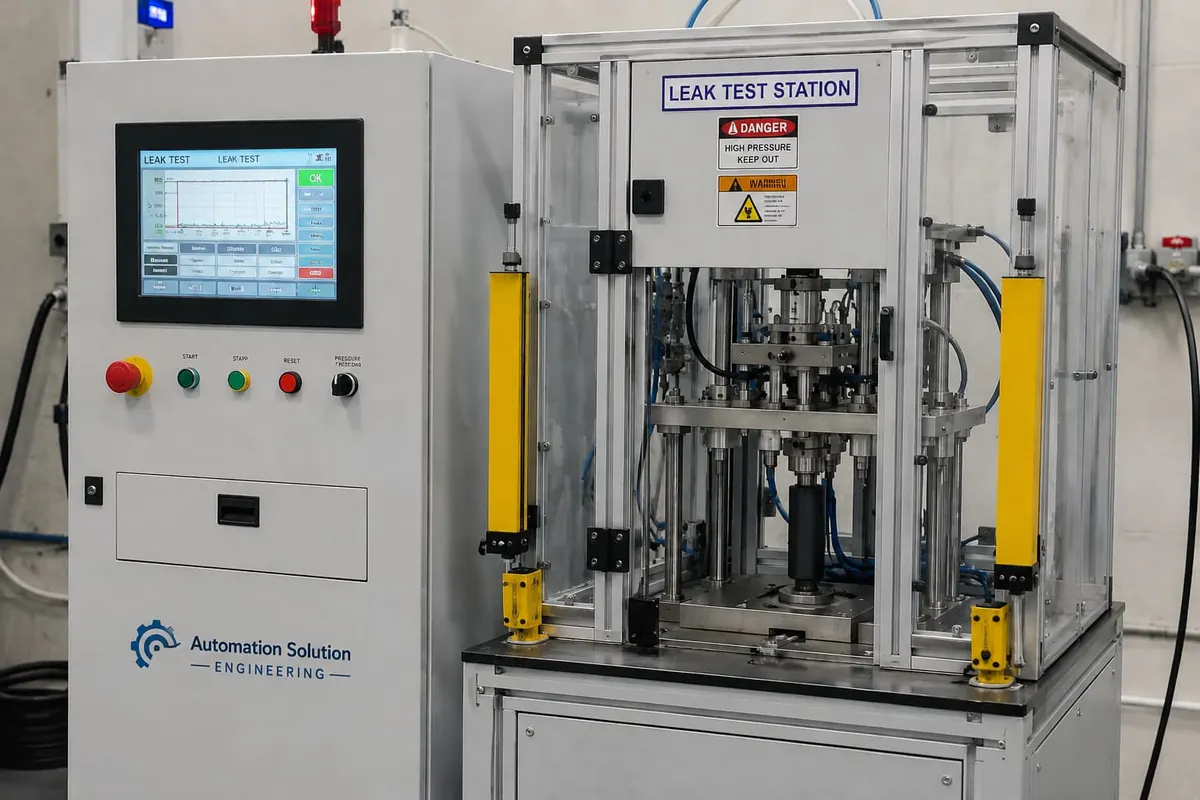
Automation Solution Engineering designs and builds leak testing SPM machines with PLC and HMI control, pneumatic clamping, pass or fail indication and reject handling. Barcode reading and data logging can be added when your customer needs traceability. Each station is built around your part, so the fixture, sealing and test program match your drawing. See our SPM machines page and the complete SPM guide for more.
A leak testing machine checks whether a component or assembly holds pressure or vacuum, or lets fluid or gas escape. It applies a defined test pressure, measures what happens over a set time and gives a pass or fail result. In production this is usually built as a special purpose machine (SPM) with automatic clamping, sealing, PLC control and reject handling.
There is no single best method. Pressure decay is the most common choice for general parts, differential pressure decay suits small leaks on stable parts, flow based testing suits parts with a known allowed leak rate, and water immersion is a simple visual method. Helium testing is kept for very fine leaks. The right choice depends on the part, the allowed leak rate and the cycle time.
Send the component drawing or sample, the test medium (air, water or helium), test pressure or vacuum, allowed leak rate, target parts per hour, and whether you need barcode reading, data logging or automatic rejection. You can call or WhatsApp 8867148793.