Automation Solution Engineering
SPM · HYDRAULIC · PNEUMATIC · CONVEYOR · PANELS
The automotive industry is the biggest user of special purpose machines. A vehicle is made of thousands of parts, and most of them are produced in high volumes where the same operation is repeated many times per shift. Doing that operation by hand or on a general purpose machine gives variation. An SPM gives the same result every cycle. This article lists where SPM machines are used in automotive component manufacturing and what to check when you plan one.
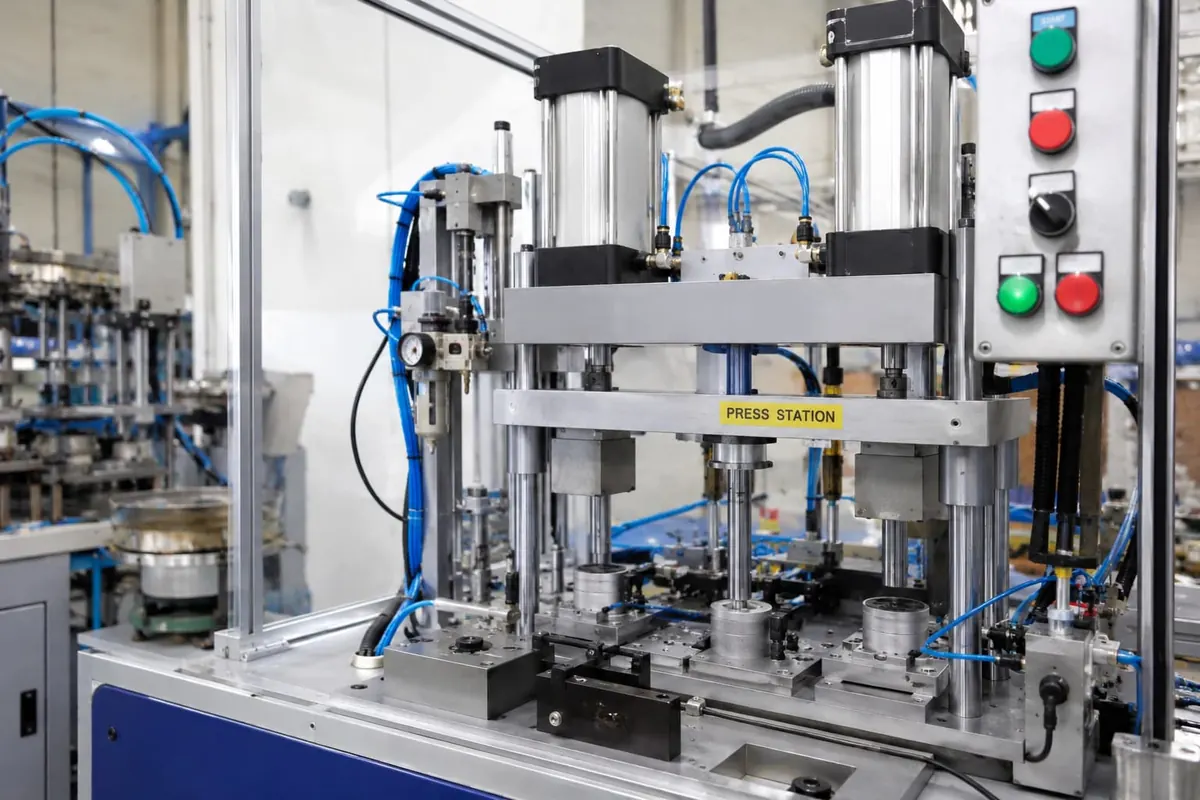
Automotive customers usually ask their suppliers for a controlled and repeatable process. In practice this means the machine should stop or reject when something is wrong, not just run. Useful features to plan for are poka-yoke sensors that stop wrong parts from being loaded, force or leak limits with a recorded result, a reject path that keeps bad parts from mixing with good ones, and serial number or batch traceability where required. These are design choices made at the beginning of the project, so mention them in your enquiry.
| Operation | Usual actuation |
|---|---|
| Light press-fit, riveting, marking | Pneumatic or pneumo-hydraulic press |
| Heavy press-fit, straightening, forming | Hydraulic press with PLC control |
| Precision assembly with force and position monitoring | Servo driven press |
| Leak testing and inspection | Pneumatic clamping with test controller or vision |
Our pages on pneumatic presses and hydraulic presses explain these options in more detail.
Automation Solution Engineering designs and builds SPM machines for automotive and general engineering customers, from a single press-fit station to conveyor integrated assembly and testing lines. Machines are built in Ankola, Karnataka and delivered, installed and commissioned at factories in Bangalore, Goa, Karwar, Pune and Mumbai. Start with the complete SPM guide or see the SPM machines page.
Automotive parts are made in high volume with tight quality requirements. A special purpose machine does one operation the same way every cycle, which improves consistency, reduces operator dependence and makes it easier to record the result of each part.
Common ones are press-fit assembly of bearings, bushes and pins, leak testing, riveting and staking, marking, fixture based welding, multi-spindle drilling and tapping, and vision based presence or defect checks.
Yes. Automation Solution Engineering builds machines at its workshop in Ankola, Karnataka and delivers and installs them at factories in Bangalore, Goa, Karwar, Pune and Mumbai.