
Automation Solution Engineering
SPM · HYDRAULIC · PNEUMATIC · CONVEYOR · PANELS
There is no single kind of leak tester. The right leak test machine depends on the part, the medium, the allowed leak rate and how many parts you make. This guide groups types of leak test machines three ways: by test method, by the part being tested and by the machine layout. If you want the working principle of a single leak test station first, read our leak testing machine guide.
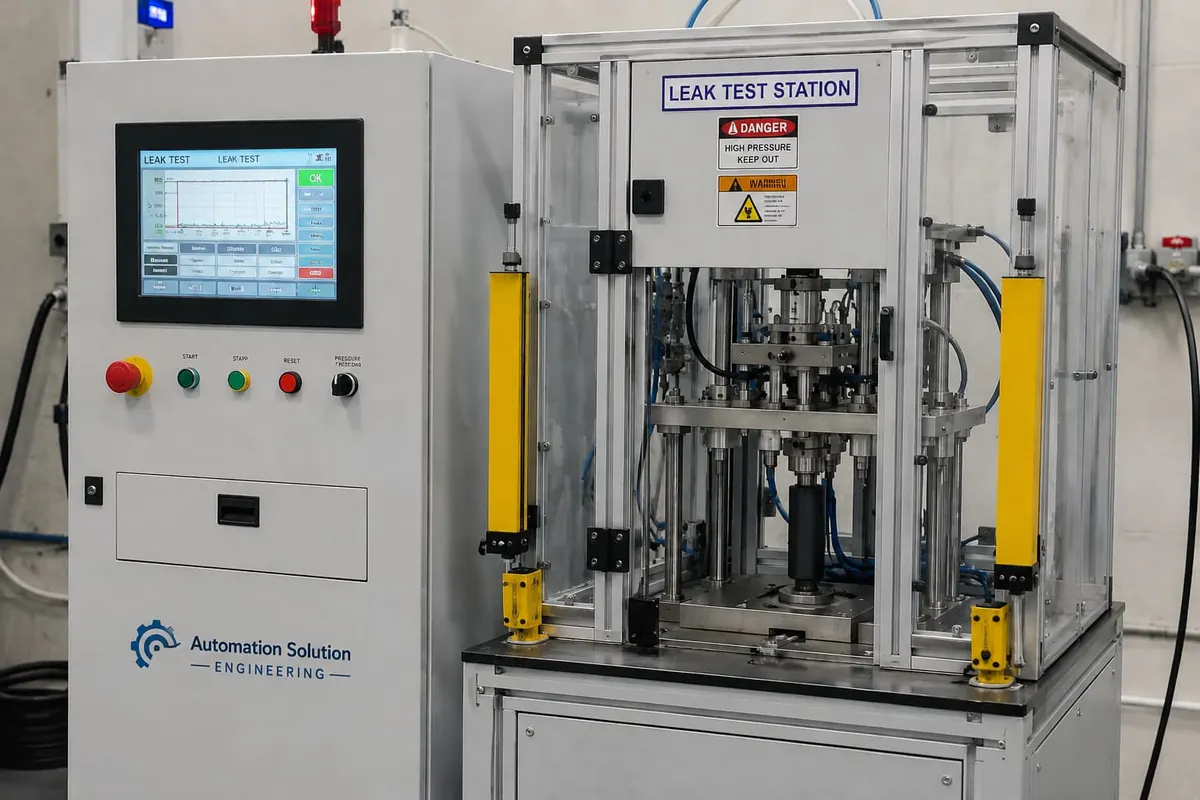
The part is filled with air, isolated, and the drop in pressure over a set time is measured. It is the most widely used method for castings, housings, fittings and valves, and works well when the part volume is stable.
The test part is compared with a sealed master volume, and only the pressure difference is measured. This cancels many temperature and expansion effects, so it can detect smaller leaks than a simple decay test.
A flow sensor measures how much air is needed to hold the test pressure. It suits larger volumes and parts with a defined allowed leak rate.
The part or pack is placed under vacuum and the rise in pressure is measured. It is used for sealed containers, pouches, packs and parts that should not be pressurised.
The pressurised part is lowered into a water tank and bubbles are watched for. It is simple, low cost and shows the exact leak location, so it is often used for rework checks or as a second stage. Automatic versions use a clamp, tank and lift mechanism with camera or operator confirmation.
Helium is introduced and detected with a mass spectrometer, either inside a vacuum chamber or with a sniffer probe. It is reserved for very fine leaks in critical parts such as refrigeration and high-reliability components.
Not a leak test as such, but often built into the same machine. It applies a higher pressure to prove a part can withstand it without failing or deforming.
| Method | Sensitivity | Typical cost level | Common use |
|---|---|---|---|
| Pressure decay | Medium | Low to medium | General production parts |
| Differential pressure | High | Medium | Small leak limits, stable parts |
| Mass flow | Medium | Medium | Larger volumes, defined leak rate |
| Vacuum decay | Medium to high | Medium | Packs, sealed containers |
| Water bubble | Low to medium | Low | Finding the leak point, simple checks |
| Helium | Very high | High | Very fine leaks, critical parts |
| Layout | Description | Best for |
|---|---|---|
| Manual bench tester | Operator clamps the part and starts the test | Low volume, workshops, rework |
| Semi-automatic station | Operator loads; clamping, sealing, testing and result are automatic | Medium volume, most factories |
| Multi-cavity station | Several parts tested at once on one fixture | Small parts, higher output |
| Rotary table tester | Parts index around load, fill, test and unload stations | High output, continuous flow |
| In-line fully automatic | Conveyor feed, test and automatic reject, often with barcode and data | High volume, traceability |
Automation Solution Engineering builds leak test stations as special purpose machines with PLC and HMI control, pneumatic or hydraulic clamping, sealing fixtures made for your part and automatic reject. Share your drawing or sample, test medium, test pressure and allowed leak rate and we will propose a design. See also the types of SPM machines and SPM machines for the automotive industry.
By method: pressure decay, differential pressure, mass flow, vacuum decay, water bubble and helium testers. By layout: manual bench testers, semi-automatic stations, multi-cavity stations, rotary table testers and in-line fully automatic testers. They are also built for specific parts such as pipes, radiators, valves, castings and containers.
Differential pressure decay and helium testing detect the smallest leaks. Differential pressure suits stable parts at lower cost, while helium is used for very fine leaks in critical parts.
Yes. Vacuum or pressure based leak testers are used on bottles, containers and sealed packs, usually inline with automatic rejection of leaking items.
Yes. It is simple, low cost and shows the leak location, so it is common for rework and as a second check. For production speed and recorded results, air based electronic testers are more common.
Send the component drawing or sample, test medium, test pressure or vacuum, allowed leak rate, target parts per hour and whether you need barcode reading, data logging or automatic rejection. You can call or WhatsApp 8867148793.