Automation Solution Engineering
SPM · HYDRAULIC · PNEUMATIC · CONVEYOR · PANELS
A special purpose machine (SPM) is built to do one job, or one group of jobs, on one component or product family, far faster and more consistently than a general machine or manual work. Because every SPM starts from the customer's part and process, there is no fixed catalogue. Still, almost every SPM falls into a small number of types. This guide lists the main types of SPM machines, what each one does and where it is used, so you can describe your requirement clearly when you ask for a quotation.
| SPM type | What it does | Typical industries |
|---|---|---|
| Assembly machine | Joins two or more parts: inserting, fitting, screwing, clipping, riveting | Automotive, electrical, appliances |
| Press-fit / pressing machine | Presses bearings, bushes, pins, seals and shafts to a set force or depth | Automotive, pumps, motors, gearboxes |
| Drilling machine | Single or multi-spindle drilling of many holes in one stroke | Castings, forgings, engine and gearbox parts |
| Tapping machine | Cuts internal threads, often with torque or depth monitoring | Housings, blocks, fittings |
| Boring / milling unit machine | Machines bores and faces using standard way-type or slide units | Machined components |
| Piercing / punching machine | Pierces holes or slots, usually with a hydraulic or servo hydraulic ram | Sheet metal, tubes, brackets |
| Riveting / crimping / staking machine | Permanently joins parts by deforming a rivet, lip or collar | Brakes, switches, hinges, terminals |
| Leak testing machine | Checks that a part holds pressure or vacuum | Automotive, HVAC, pumps, containers |
| Functional / end-of-line test machine | Tests torque, flow, force, electrical values or full performance | Pumps, motors, valves, assemblies |
| Vision inspection machine | Camera checks presence, dimension, orientation and defects | Any high-volume production |
| Marking machine | Laser, dot-peen or ink marking of part numbers, QR and batch codes | Automotive, engineering, pharma |
| Screw / nut tightening machine | Tightens fasteners to a controlled torque and angle | Engines, panels, appliances |
| Feeding, sorting and orientation machine | Bowl feeders, hoppers and magazines that present parts correctly | All assembly lines |
| Filling, sealing, packing and palletising machine | Fills, seals, counts, loads or stacks finished goods | Food, FMCG, auto components |
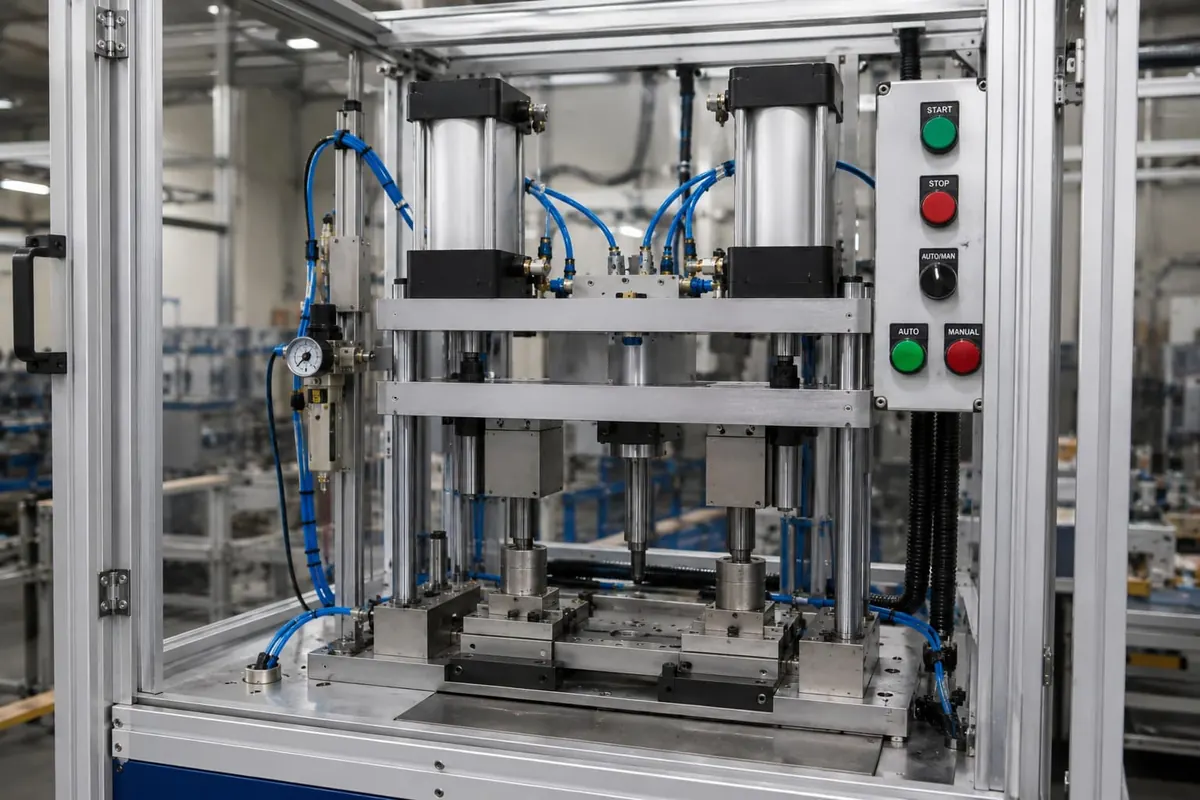
Assembly machines bring parts together in the right order and position. A simple one may be a manual-load station with a pneumatic cylinder that pushes a component into place. A complex one feeds parts automatically, assembles them, checks the result and rejects a bad assembly. Assembly SPMs reduce missing parts, wrong orientation and operator-to-operator variation.
Pressing machines are among the most common SPMs. They press bearings, bushes, oil seals, pins or gears using a pneumatic press, a hydraulic press or a servo press. Better machines monitor force against position so a missing, oversize or damaged part is caught. Read our guide to choosing hydraulic, pneumatic or servo press-fit for details.
These machines do metal cutting. A multi-spindle drilling head can drill many holes at once at fixed positions, while tapping units cut threads with depth control and, in better designs, torque monitoring. Boring and milling are built from standard slide or way-type units mounted on a base with a part fixture. They are widely used on castings and forgings where the same holes are needed on thousands of parts.
Piercing SPMs make holes or slots in sheet metal, tubes and brackets by pushing a punch through the material. Hydraulic rams give high force with smooth control and are common for thicker or longer strokes, while servo-controlled systems improve repeatability and reduce deformation around the hole.
These machines join parts permanently by deforming metal or plastic. Orbital and radial riveting, hydraulic crimping and staking are used where welding or screwing is not suitable, such as brake components, switches, hinges and terminals. Controlled force prevents loose or over-formed joints.
Leak test SPMs clamp and seal a part, apply air, water or helium and decide pass or fail. They are covered in detail in our leak testing machine guide and the types of leak test machines article.
An end-of-line tester checks that the finished product actually works: running a pump and measuring flow, checking torque on a rotating part, measuring electrical values or testing force on a switch. Results can be stored against a serial number for traceability.
A camera, lighting and software check whether a part is present, correctly oriented, within dimension and free of visible defects. A reject mechanism then removes bad parts. See the vision inspection and reject machine guide.
Counting, loading into trays or cartons, sealing and stacking are often built as SPMs together with belt conveyors. For food and packaging lines see our guide on food processing and packaging machines.
| Layout | Description | Best for |
|---|---|---|
| Standalone single station | One operation at one station, usually operator loaded | Low to medium volume, lowest cost |
| Rotary index table | Parts move around a table to several operations in turn | Compact multi-step assembly or test |
| In-line / transfer line | Stations arranged in a line linked by conveyor or shuttle | High volume, many operations |
| Pick-and-place / gantry cell | Pneumatic, servo or robotic handling between stations | Heavy parts, flexible layouts |
Automation level, drives and controls are the main factors behind price. Our article on SPM machine cost factors explains this in detail.
Automation Solution Engineering designs and builds special purpose machines, hydraulic and pneumatic presses, belt conveyors and electrical control panels for customers in Bangalore, Goa, Karwar, Pune, Mumbai and across India. Each machine is engineered for your component, with PLC control and the safety features your process needs. Start with the SPM machines page or the complete SPM guide.
The main types are assembly machines, press-fit machines, drilling and tapping machines, piercing and punching machines, riveting and crimping machines, leak testing machines, functional test machines, vision inspection machines, marking and tightening machines, feeding machines and packing or palletising machines. Many real machines combine several of these in one line.
A CNC machine is a general purpose machine programmed to make many different parts. An SPM is built around one part or process, so it runs faster and more consistently for that job, but it is not meant to be re-used for unrelated parts.
Yes. Combination machines can drill or tap, assemble parts, inspect with sensors or a camera and reject bad parts in one cycle, usually on a rotary table or an in-line layout. This reduces handling and floor space.
Send the component drawing or sample, the operation you want to automate, target parts per hour, available air or power supply, and whether you need data logging, barcode reading or automatic rejection. You can call or WhatsApp 8867148793.