
Automation Solution Engineering
SPM · HYDRAULIC · PNEUMATIC · CONVEYOR · PANELS
A conveyor moves material or products from one point to another with less labour, damage and time. The types of industrial conveyors differ in how they carry the load, what they can carry and how they are cleaned or maintained. This guide covers the main types, their uses and how to choose, building on our belt conveyor design guide.
| Conveyor | Carries | Typical use |
|---|---|---|
| Belt conveyor | Boxes, parts, packs, bulk material | Assembly lines, packing, food, general handling |
| Chain / pallet conveyor | Heavy parts and pallets | Automotive lines, heavy assemblies |
| Roller conveyor (gravity or powered) | Cartons, crates, pallets | Warehousing, dispatch |
| Slat conveyor | Heavy or hot parts | Machining and press shops |
| Screw (auger) conveyor | Powders, grains, granules | Feeding hoppers, processing plants |
| Bucket elevator | Bulk material lifted vertically | Grain, granules, aggregates |
| Inclined / cleated belt | Items lifted to a higher level | Loading hoppers, machines |
| Pneumatic conveyor | Fine powders and light granules | Closed, dust-free transfer |
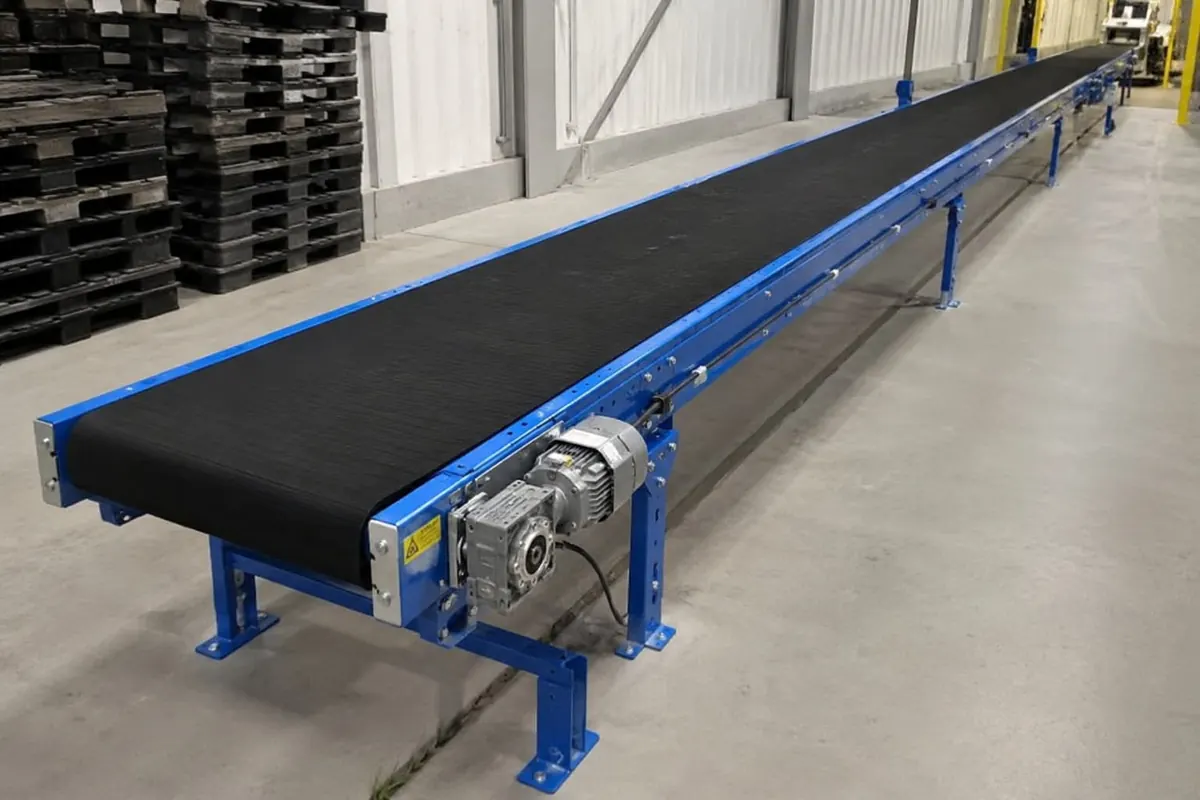
The most common type: a continuous belt runs over pulleys driven by a geared motor. Belt material (PVC, PU, rubber, modular plastic) is chosen for the product, with options like cleats, side guards and speed control through a VFD. For food use see food-grade conveyor options. More on our belt conveyor page.
Chains carry heavy or hot loads that a belt cannot, and are widely used to carry pallets through assembly and testing stations. They need lubrication and chain tension checks.
Gravity roller conveyors use a slight slope and need no power. Powered roller conveyors are driven by chain or belt and suit cartons and pallets. Accumulation versions let loads queue without crushing each other.
Screw conveyors push loose material along a trough or tube and are good for dosing and enclosed transfer. Bucket elevators lift bulk material vertically in a compact footprint.
Conveyors link machines: they feed SPM machines, accumulate parts, carry parts to inspection and reject stations and take finished goods to packing. Sensors, a PLC and VFDs keep speed and stopping positions in step with the machines. See PLC and HMI control panels.
Automation Solution Engineering designs and builds belt conveyors and custom handling systems with matching electrical control panels for customers in Bangalore, Goa, Karwar, Pune and Mumbai. Share your product, layout and capacity to receive a proposal.
The main types are belt, chain or pallet, roller, slat, screw, bucket elevator, inclined cleated belt and pneumatic conveyors. Each suits different loads, environments and layouts.
Belt conveyors and powered roller conveyors are the most common choices for boxes, cartons and packs, depending on the base of the box and the need for accumulation.
Chain or pallet conveyors and heavy-duty roller or slat conveyors are used for heavy or hot parts and pallets.
Send the product details and weight, conveyor length, width, incline, speed or capacity, operating environment and any accumulation or stop requirements. You can call or WhatsApp 8867148793.