Automation Solution Engineering
SPM · HYDRAULIC · PNEUMATIC · CONVEYOR · PANELS
When one machine is not enough, factories link several stations into an automatic assembly line or transfer line. Parts move from station to station, each doing one operation: loading, pressing, tightening, testing, marking, inspection and packing. This guide explains the main layouts, the stations used and what to plan before ordering. It follows from our list of SPM machine types.
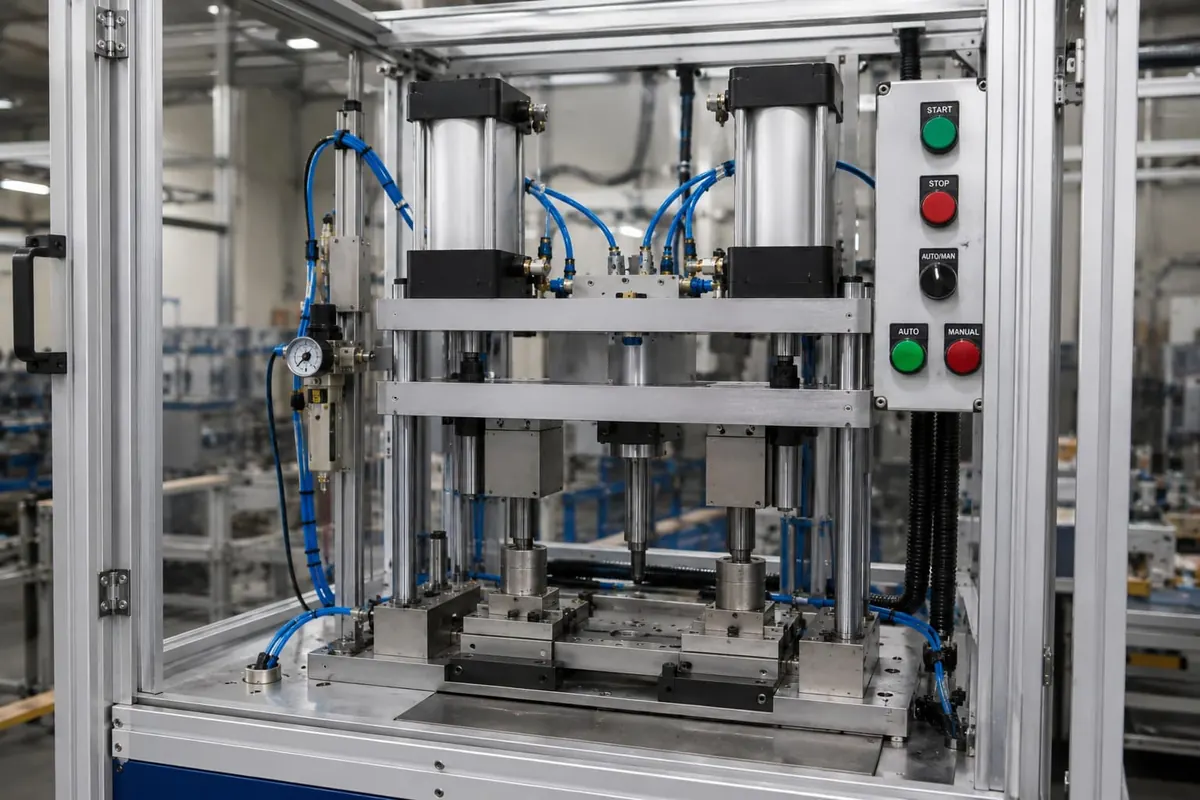
An assembly line joins parts into a finished product. A transfer line moves a workpiece through a series of machining or processing stations, such as drilling, tapping and boring. In practice the two terms overlap, and many lines combine machining, assembly, testing and packing.
| Layout | How parts move | Best for |
|---|---|---|
| In-line (straight) | Conveyor or shuttle carries parts station to station | Many operations, long cycle products |
| Rotary index table | A table turns step by step to each station | Compact, shorter operations, one product family |
| Pallet conveyor loop | Parts ride on pallets that circulate on a conveyor | Flexible lines, heavier parts, many variants |
| U-shape or cell | Stations around an operator or robot | Small footprint, flexible production |
| Gantry or pick-and-place | Pneumatic or servo handling moves parts between stations | Heavy or delicate parts |
A PLC coordinates the stations, conveyors, sensors and reject systems, while an HMI shows status, alarms and counts. VFDs control conveyor speeds. The electrical panel must be sized and laid out for the whole line. See PLC and HMI control panels and industrial conveyor types.
Many factories start with one or two stations and add more as volume grows. Planning the conveyor layout, panel capacity and PLC program for later expansion avoids rebuilding the line later.
Automation Solution Engineering designs and builds special purpose machines, conveyors and control panels, and links them into assembly and test lines for customers in Bangalore, Goa, Karwar, Pune and Mumbai. Share your part drawings, target output and the operations needed to receive a layout and proposal.
A transfer line moves a workpiece automatically through a series of stations, each performing one operation such as drilling, tapping, boring, testing or assembly. It is built from SPM stations linked by a conveyor, shuttle or index table.
A rotary index machine turns a table step by step to each station and is compact. An in-line layout carries parts along a straight conveyor and suits many operations or long cycle times.
Output depends on the cycle time of the slowest station, so stations are balanced to take similar time. Buffers and good changeover design protect output.
Send part drawings or samples, operations required, target output per shift, number of variants, available floor space and utilities. You can call or WhatsApp 8867148793.